The First and Last Slides Your Pitch Deck Needs
I recently spent an hour with our portfolio founders at the annual Ubiquity CEO Summit talking about fundraising. We covered a lot, but one recommendation deserved more time: what to put on the first and last slides of your pitch deck.
It’s advice I find myself giving founders repeatedly:
- Start strong: A great pitch deck starts by helping the investor understand exactly where your company stands today.
- End strong: Then it brings the story full circle by showing what the company will look like after you’ve put this round of funding to work.
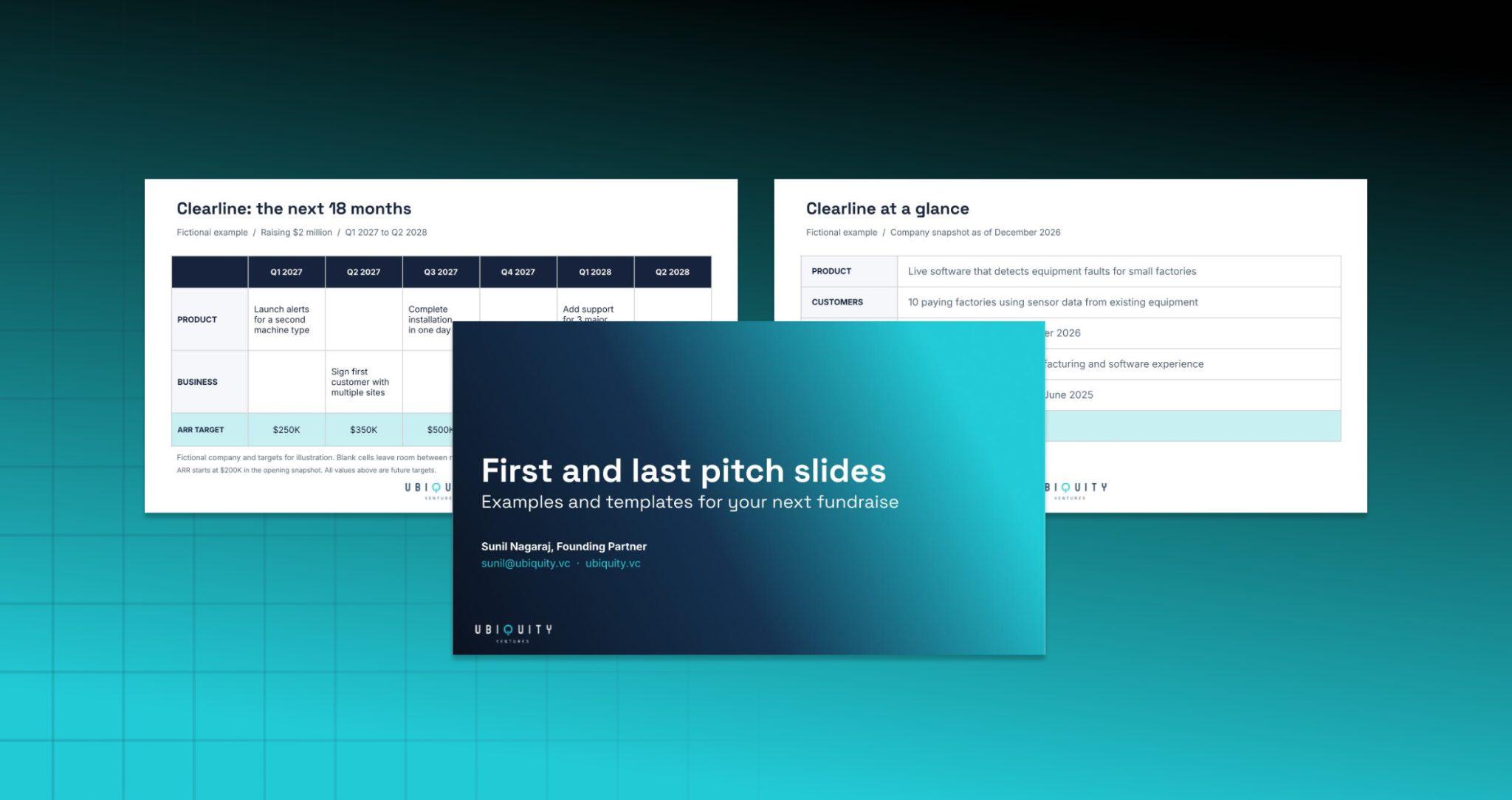
We’ve turned those two slides into a simple template you can adapt. As pre-seed and seed investors, one of our goals at Ubiquity is to share useful resources with founders, both in our portfolio and across the broader startup community. Like our six-slide board deck and ARR waterfall dashboard, this template is designed to make an important conversation more productive.
Download the template hereStart with your company at a glance
One of the most important things I recommend when founders fundraise is an “at-a-glance slide”, right at the beginning of the deck. Give investors a straightforward picture of your company today, even if the numbers feel small.
You might say: four people, product live, $200,000 in ARR, raising $2 million. None of that has to sound impressive. What it does is lower the temperature in the room so we can have a real conversation about what’s going on.
The opposite is waiting until the end to reveal those facts. Your audience is nervous the whole time, trying to figure out the basics while you’re explaining everything else. Are customers using this product already? How many people are building it?
Give me a handful of straightforward facts about the product, customers, traction, team and financing so I can think, “Okay, I get it.”
Finish with the company you intend to build
Here’s my pet peeve: founders often end their pitch with a “use of funds” slide showing how much they’re raising and how they’ll spend it. For example, 45% on engineering, 35% on sales and marketing, and 20% on infrastructure.
Of course early-stage companies spend the majority of their funding on people and technology. These percentages don’t tell me much about your particular business. I want to know what those hires will build, what customers will be able to do, and what you’ll have proven by the time you need to raise again.
If you buy into the at-a-glance slide at the beginning, use that same framework at the end. Show me what you expect the company to look like in 18 months, once you’ve spent most of the money you’re raising. That’s the future company you’re asking investors to buy a slice of today.
Lay out the milestones quarter by quarter
Use six quarterly columns covering 18 months, with two main rows:
- Product: the technical and product milestones you expect to achieve.
- Business: the commercial milestones you expect to achieve.
Add a row for a relevant measure, such as ARR, customers, deployments or headcount, if it helps explain the plan.
Aim for two to four meaningful milestones in each category across the full plan. You don’t need to fill every cell. Some quarters might have a product launch; others might have a customer milestone. It’s fine to leave space.
Clarity matters more than salesmanship here. “Launch the Android app” or “convert a pilot into a paying customer” tells me much more than “expand our platform.”
Help the investor see the next financing, too
The investor needs to convince their partners to invest today, while also thinking about who will fund you in 12-18 months at your next round.
Looking at your milestones, they’re asking, “If this team hits half or two-thirds of its plan, would my downstream Series A or Series B colleagues want to invest?” Several concrete milestones give them reasons to believe in your progress even if some things take longer than expected.
Try filling in these two slides before revising the rest of your deck. Knowing where you’re starting and what this round will help you accomplish makes it easier to decide what belongs in between.
For more practical advice, visit Ubiquity University, our free library of sessions on fundraising, board meetings and building a company. And if there’s a template or topic you’d find useful, let us know.
